Toyota and Lexus are among the best-selling car brands in the world, and people look for their parts every day: for the Corolla and Camry, RAV4 and Land Cruiser, Hilux and Prado, Lexus RX and LX. But the Toyota OEM catalog works differently from what you may know from European brands: one model has several catalogs for different markets, Japanese-market cars are identified by a frame number instead of a VIN, and the same position on a diagram can resolve to different part numbers depending on the trim.
All of this is now available through plan.parts — with the same API key you use for the other catalogs.
What the Toyota / Lexus catalog API does
- Vehicle lookup by VIN (17 characters) — for European, US and general-market cars.
- Lookup by frame number (for example
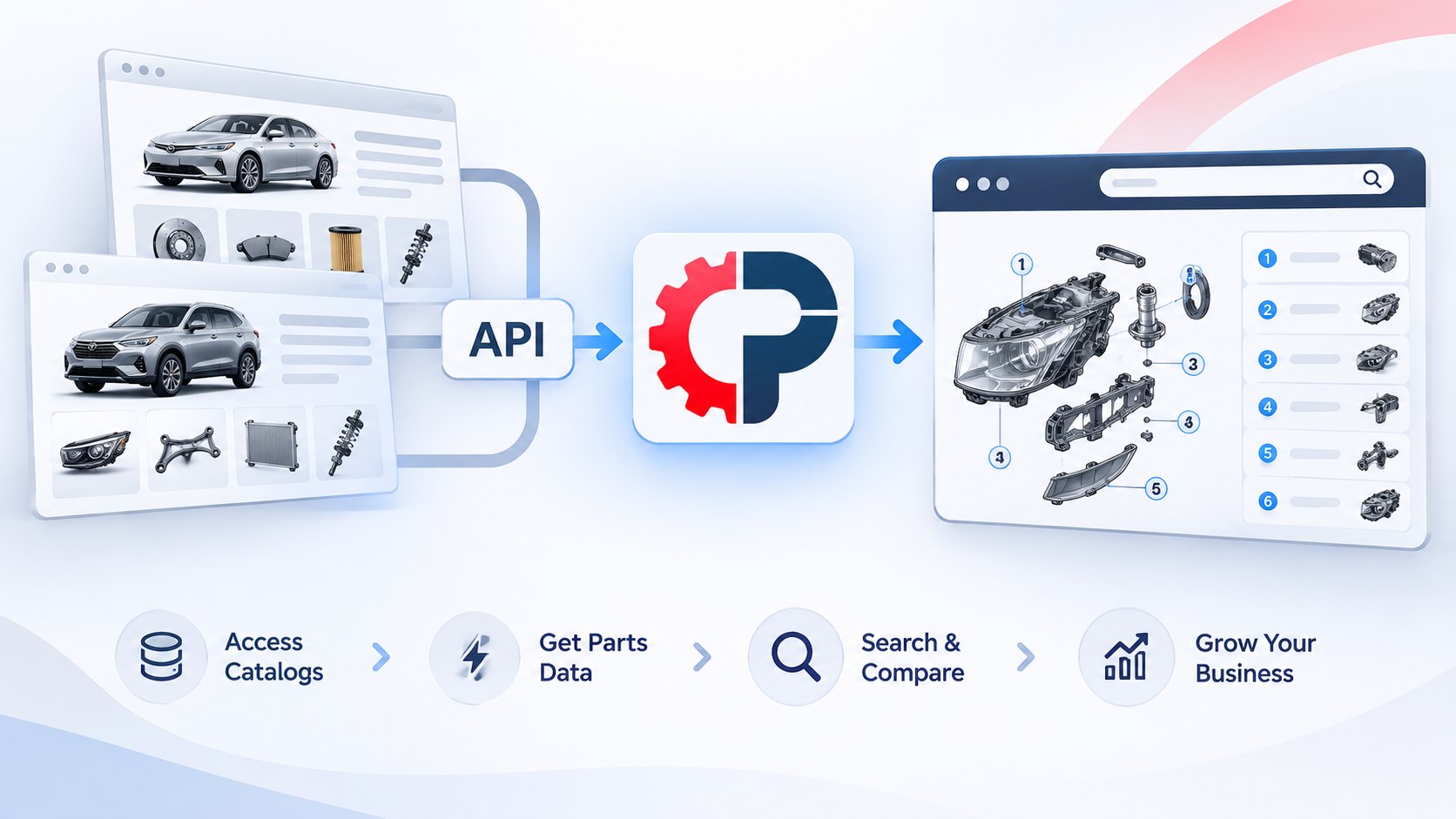
A201A-0113569) — for Japanese-market cars, including right-hand-drive imports. - Illustrated catalog: assembly groups → diagrams → clickable callouts (PNC) with their coordinates on the image. You can build the same experience as a dealer parts catalog.
- OEM part numbers per callout, filtered for the exact vehicle: engine, transmission, body type, production period.
- Supersessions — which part number replaced an older one.
- Part fitment: which models and variants use an OEM number.
Four markets
| Code | Market |
|---|
| EU | Europe |
| JP | Japan |
| US | USA and Canada |
| GR | General market: Middle East and the Gulf (GCC), Asia, Africa, Latin America, Australia |
Hundreds of Toyota and Lexus models — from the Aygo and Auris to the Land Cruiser, Highlander, Sequoia and Tundra; from the Lexus IS and ES to the RX, NX, GX and LX. Commercial vehicles such as the Hiace, Dyna and Coaster are covered too.
How a lookup works
GET /v1/toyota/vin/{vin}                      → the vehicle and its params
GET /v1/toyota/vehicle/figures?{params}       → groups and diagrams
GET /v1/toyota/vehicle/illustrations/{code}   → the image and its callouts
GET /v1/toyota/vehicle/pnc/{pnc}?{params}     → OEM part numbers for this vehicle
If a VIN exists in several market catalogs, the API says so and asks you to specify the market — instead of silently picking the wrong one.
See it in the demo
In the Toyota / Lexus catalog demo you can enter a VIN or frame number, walk through the diagrams and see the part numbers — free once you have registered. To work through the API you need a key, which you can create in your account. All endpoints are described in the documentation; the catalog overview is on the Toyota / Lexus page.
An empty result costs no tokens: if nothing is found, you pay nothing. Current request prices are on the pricing page.
Toyota, Lexus and VAG — one API
The Toyota / Lexus catalog sits next to the VAG catalog (Volkswagen, Audi, Škoda, SEAT, Porsche) and the aftermarket cross-reference database. For a parts shop, a repair shop or a marketplace that means one integration instead of several: customer's VIN → OEM number → aftermarket alternatives.
Need bulk processing — say, adding Toyota OEM numbers to a price list with tens of thousands of rows? Submit a data task and we will do it for you.